

Press Release
Hyundai E&C Sets Out to Secure Core Technology for Next-Generation Hydrogen Production via Water Electrolysis
■ HMG Construction Technology Research Institute undertakes national R&D project on water-electrolysis hydrogen production … concentrating its integrated R&D capabilities
… Developing Pre-FEED and FEED technologies for water-electrolysis plants targeting the large-scale hydrogen production market
… Establishing a standard model for water-electrolysis plants that applies AI-based optimization solutions and dynamic process simulation
■ Hyundai Motor Group Consolidates Its Hydrogen Technology Capabilities to Strengthen Its Leadership in Next-Generation Water Electrolysis Hydrogen
… Building a Korean green hydrogen platform that integrates core capabilities across hydrogen production, storage and transportation, and utilization
… Accelerating its transformation into a global energy company by strengthening hydrogen business capabilities, including the in-house development of core water electrolysis technologies
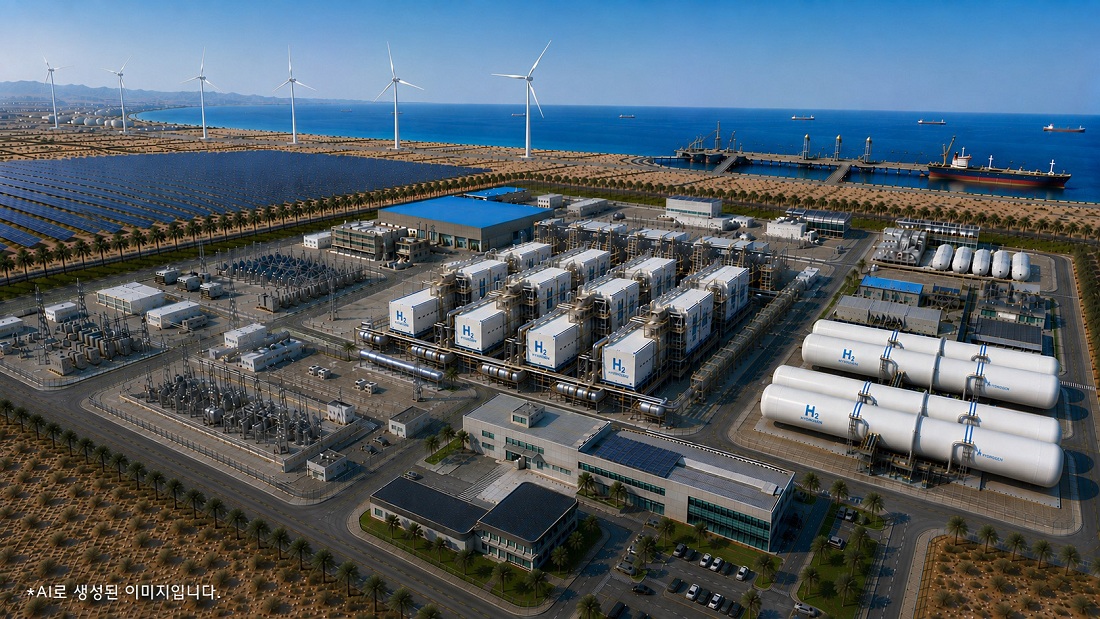
Hydrogen production plant using water electrolysis powered by renewable energy AI-generated image
Hyundai E&C is moving to enhance its competitiveness by securing core technologies for next-generation water electrolysis plants.
The Korean builder announced on Friday the 18th that it will participate in a government-funded R&D project led by the Ministry of Climate, Energy and Environment to develop design technologies for large-scale water electrolysis plants with a capacity of 100 MW or more.
As maximizing the use of renewable energy, standardizing large-scale plants, and optimizing systems emerge as key priorities in the water electrolysis plant market, Hyundai E&C plans to use the government-funded project to build integrated capabilities for large-scale hydrogen production systems linked to renewable energy and strengthen its ability to respond to evolving market conditions.
The “Front-End Engineering Design Technology Development for 100MW-Class Overseas Water Electrolysis Plant” project aims to secure a design package for water electrolysis plants targeting the large-scale hydrogen production market. The project seeks to develop a comprehensive solution encompassing system design, core process design, and operational configuration, and to advance it to a level suitable for demonstration and commercialization.
For this government-funded project, Hyundai E&C serves as the lead contractor, heading a consortium that includes Hyundai Engineering, Hyundai Motor Company, Hanwha Global, Korea Midland Power, the Future Standards Research Institute, Seoul National University, and Korea University. Hyundai E&C is responsible for developing the Front-End Engineering Design (FEED) package and conducting a feasibility study. In particular, the project will apply artificial intelligence and dynamic simulation models to address fluctuations in renewable energy output while enhancing the stability and reliability of plant operations.
Hyundai E&C has steadily built its technical capabilities and experience in water electrolysis through projects including the construction of a hydrogen production facility in Buan, Jeonbuk, and the development of a 5 MW plant-scale PEM water electrolysis system in Jeju.
A Hyundai E&C official stated, “The results achieved through this R&D will serve as a key asset in strengthening our competitiveness in securing future water electrolysis projects in Korea and overseas.” The official added, “The HMG Construction Technology Research Institute, which is carrying out this project, will consolidate Hyundai Motor Group’s core technological capabilities across the entire hydrogen value chain, from production and storage to transportation and utilization, to establish a Korean-style green hydrogen platform, while further solidifying its leading position in the next-generation water electrolysis hydrogen business.”
Meanwhile, the HMG Construction Technology Research Institute, the integrated R&D organization of Hyundai E&C and Hyundai Engineering, is focusing on generating R&D synergies across four core areas including △ Energy, △ Future Housing, △ Smart Construction, and △ Infrastructure, to secure future growth engines. In particular, the institute plans to accelerate research in future energy sectors, including hydrogen, SMRs, SAF, offshore wind power, and biogas, to expedite its transformation into a global energy player.
